

December 2024
María García-Catalán, Judith Pascual, Ferrán Soldevila, Mayte Fernández.
Bioregulatory Services, S.L.
The Spanish-language original of this article was published in Phytoma Spain / No. 357 / March 2024. It has been translated, edited for clarity and brevity, and republished with permission from the authors and Phytoma Spain.
This article discusses the regulation of biopesticides in India, China, Africa (Nigeria, South Africa, and Kenya), Latin America (Brazil, Argentina, Mexico, Peru, Ecuador, Colombia, and Chile), and the United States. Our overview outlines registration times, required information, and the organisations involved, as well as highlighting market trends in each territory.
In terms of regulation, various countries have developed specific regulatory frameworks for these products, considering their properties and mode of action in the crop. However, differences in evaluation timelines and regulatory requirements can create barriers to the global commercialisation of biopesticides.
The annual growth in the biopesticide market reflects an awareness of the importance of sustainability in agriculture. Investment in research and development and the expansion of the supply of these products contribute to the consolidation of biopesticides in integrated pest management.
In conclusion, countries with specific regulations for biopesticides demand product studies that align with their nature and toxicological profile, managing shorter registration times. This encourages companies to invest in the development of biopesticides, thus promoting more sustainable agricultural practices.
Introduction
Current agricultural production is oriented not only towards crop profitability but also towards environmental sustainability. In this context, biopesticides stand out as a clear option for promoting more sustainable agricultural practices to be considered in Integrated Pest Management programs. A biopesticide is a type of pesticide derived from natural materials such as animals, plants, bacteria, and/or certain minerals (EPA, United States Environmental Protection Agency, n.d.).
Although biopesticides have origins dating back to the 19th century, their market remains small compared to conventional pesticides. Recently, the biopesticide sector has expanded rapidly, driven by the quest to reduce the impact of agriculture on the environment and, at the same time, benefiting from advances in R&D in biology and agricultural production.
The prolonged use of conventional pesticides has generated problems, notably the serious resistance developed by pests. This resistance reduces the effectiveness of conventional pesticides, increasing their application, and generating significant consequences for human health and the environment due to the residual toxicity of these.
According to Triton Market Research published in September 2023, the Global Biopesticides Market was valued at $5.826.46 million in 2022 and is expected to reach $17.941.26 million by 2030, with a growth rate of 15.13% during the period 2023-2030.
Globally, the European Union stands out for a lower number of biopesticide registrations compared to other countries such as Brazil, the United States, China, and India. This outcome is attributed to the complex European registration process (Damalas and Koutroubas, 2018). Below, we explain the main features of the process for bring biopesticde products to market in selected key markets outside Europe.
India
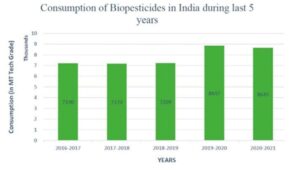
The consumption of biopesticides in India constitutes approximately 9% of the total pesticide market, with projections suggesting it could reach 50% of the pesticide market by 2050, with an annual growth rate of 2.5% (Keswani, 2020). The 2007 National Agricultural Policy supports the use of biopesticides for sustainable agriculture, and records indicate an increase in their use in recent decades in India (Chakraborty et al., 2023). This trend in the use of biopesticides is reflected in Figure 1.
Graph 1. Consumption of biopesticides in India from 2016 to 2021 (Chakraborty et al., 2023).
Regarding the current regulations on biopesticides in India, the Central Insecticides Board and the Registration Committee (CIBRC) are responsible for enforcing the Insecticides Act of 1968 and the Insecticides Rules of 1971, which regulate the use of biopesticides in the country. According to Article 9.3(b) of this law, a provisional period of two years from the registration application is established for new imported or manufactured biopesticides, with the possibility of a six-month extension if the Registration Committee does not issue a decision within the stipulated period. The current registration system in India facilitates the commercial development of microbial pesticides by allowing producers to obtain a provisional registration while awaiting full approval.
China
According to data from the Institute for the Control of Agrochemicals, Ministry of Agriculture (ICAMA), in 2022, nine new active substances and 574 formulated products were registered, making a total of 2,023 biological solutions (including, among others, biostimulants and low environmental impact products) approved in China.
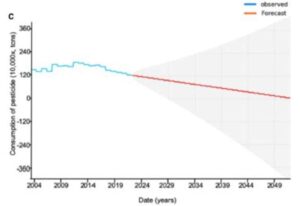
The Chinese biopesticide market will experience a compound annual growth rate (CAGR) of 4.6% during the period 2020-2025. Additionally, according to ARIMA (Autoregressive Integrated Moving Average) model projections based on previous consumption data, it is anticipated that by 2050 zero consumption of conventional pesticides will be achieved (Figure 2). The grey areas in Figure 2 indicate the maximum predicted relationship, either positive or negative, observed between the consumption of chemical pesticides and the corresponding year (Wang et al., 2022).
Graph 2. Consumption of chemical pesticides in China from 2004 to 2050 (Wang et al., 2022).
The oversight and approval of registration lie with two key bodies: ICAMA (Institute for the Control of Agrochemical Products, Ministry of Agriculture) and MoARA (Ministry of Agriculture and Rural Affairs). The latter only accepts data generated by previously accredited local laboratories or by foreign laboratories from countries or organisations with Mutual/Multilateral Data Acceptance (MAD) agreements with China (REACH24H Consulting Group, 2019). As of March 2022, no such agreement had been signed.
Biological pesticides (microbial, biochemical, and botanical) require significantly fewer tests than conventional products, as indicated in the pesticide registration requirements in China, published in 2017. This implies a reduction in registration costs and time for companies.
Before initiating registration, it is essential to verify if the active substance is already registered in the country. For new biopesticides, the active substance and the formulated product must be registered together, but not necessarily by the same applicant. In other cases, it is allowed to register the active substance and the formulated product separately. The evaluation and approval time for registration varies from six months to one year.
The biopesticide product registration certificate is valid for five years, and between 180 and 90 days before its expiration, the renewal application must be submitted.
Africa
The biopesticide market in Africa is developing, representing only 3% of the global market (Akutse, K.S., et al., 2020). The following details the registration and trade process of biopesticides in Nigeria, South Africa, and Kenya, the most important markets.
Nigeria
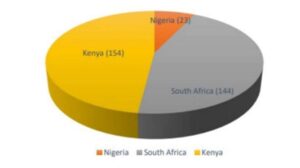
Despite interest in promoting biopesticides in Nigeria, the number of registrations is limited compared to countries like South Africa and Kenya (Figure 3, Ashaolu C.A. et al., 2022).
Graph 3. Registered biopesticides in July 2021 in Nigeria, South Africa, and Kenya (Ashaolu, C.A et al., 2022).
The regulation of biopesticide registration in Nigeria is governed by the Biopesticide Registration Regulation, 2019. For information on the required studies and whether it is necessary to submit details on the active substance, it is necessary to contact the National Agency for Food and Drug Administration and Control (NAFDAC). This entity is responsible for carrying out technical and documentary reviews to ensure the safety and efficacy of the products before granting the corresponding authorisation (Ashaolu, C.A et al., 2022).
For biopesticide products, there is no specific evaluation time established. However, the Pesticide Registration Guide states that the estimated evaluation time is 120 working days for conventional pesticides. It is important to note that once registration is obtained, it is renewed every five years (Ashaolu, C.A et al., 2022).
South Africa
As of July 2021, South Africa had 144 registered biopesticides. The Department of Agriculture, Land Reform and Rural Development is responsible for the registration of these products, regulated by the Act No. 36 of 1947 (Ashaolu C.A., et al., 2022), the most recent version of which was published in August 2023, updating data on the registration and use of “agricultural remedies” (biopesticides). Among the modifications made, the introduction of a category of low-risk active substances is included (Republic of South Africa, 2023).
The formulated product is registered, but data on the active substance are required. The evaluation lasts from six to twelve months, according to official information, and the registration certificate is valid for three years.
Additionally, as a clear indication of the country’s commitment to more sustainable agricultural practices, in November 2023, a protocol for the fast-track registration application was published. This protocol grants priority and speed to the registration of products that can replace agricultural pesticides identified as concerning substances due to their toxicological characteristics (Republic of South Africa, 2023).
Kenya
Kenya is one of the countries with the most registered biopesticides in Africa. As shown in Figure 3, in July 2021, there were 154 registered biopesticides, ahead of South Africa and Nigeria. Over the past decade, the number of registration applications for biopesticide products has increased due to concerns about maximum residue limits at the local level, in European markets, and other export markets (Ashaolu C.A., et al., 2022).
The legislation in Kenya, under Chapter 346 of the Laws of Kenya, regulates the registration of pesticides, including biopesticides, categorised into microbial, biochemical, macrobial, and conventional pesticides. The formulated product is registered, although information on the active ingredient is required depending on the category. The evaluation, conducted by the Pest Control Products Board (PCPB), has an estimated duration of six to eight months. The registration certificate is valid for three years.
Latin America
Latin America is solidifying its position as the global leader in the biocontrol products market. It is expected that by 2030, the region will account for 29% of the global market for these products (Biologicals Latam, 2023).
Brazil
Brazil stands out in the consumption of biopesticides with remarkable growth in recent years. While the global expansion rate of these products was 16% between 2017 and 2020, Brazil experienced an increase of 42% during the same period.
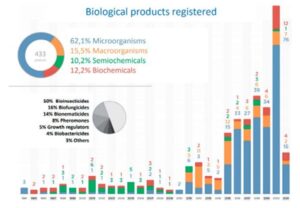
In 2020, the biopesticides market revenue in Brazil reached 268 million dollars, representing a 35% increase compared to the previous year. The trend in Brazil is clear, going from 104 biopesticide registrations in 2013 to 433 in 2021, as detailed in Graph 4 (Barros, S., and Coffani, V., 2022).
Graph 4. Biological products registered in Brazil per year from 1991 to 2021 (Ministry of Agriculture, Livestock, and Supply (MAPA), 2021).
According to Gottems, G. (2024), in 2023, out of the 365 approved pesticide products, 90 were classified as low risk, highlighting the growing importance of environmentally friendly approaches in agriculture.
In Brazil, a new law, Law No. 14,785 of December 27, 2023, has been approved, regulating the registration of pesticides, including biopesticides. This law establishes new timeframes for obtaining registration, ranging from 24 months for new products (formulated or technical) to 60 days for identical formulated products. For biological products, the evaluation period has been reduced to 12 to 18 months.
The registration process involves three agencies: the Ministry of Agriculture, Livestock, and Supply (MAPA), the Ministry of Health (ANVISA), and the Ministry of the Environment (IBAMA). Registration requires federal approval followed by state approval to allow the commercialisation of products at the local level.
Argentina
According to the Chamber of Agrochemical and Fertiliser Health (CASAFE), the bio-inputs market in Argentina is experiencing an annual growth of 15% to 17%, mobilising around 100 million USD. Although it is surpassed by agrochemicals and fertilisers, it shows a steady increase (AgriBio, 2023).
On October 18, 2023, the National Food Health and Quality Service (SENASA) of Argentina presented Resolution 1004/2023, which states that it is necessary to register the formulated product and provide information on the active substance to obtain registration. This measure reinforces the compliance with stringent safety and efficacy standards for such products. As part of this update, it is estimated that the evaluation of active substances will take a minimum of 18 months from submission, while for formulated products, the evaluation time is estimated to be around twelve months (SENASA, 2023).
Mexico
According to Agtech America projections from November 2022, the biopesticides market in Mexico is expected to reach 11.3 billion USD by 2027, with a compound annual growth rate of 15.6%. Microorganisms represent the predominant source of biopesticides, with a value of 3.537 billion USD in 2022.
The PLAFEST regulation, in effect in Mexico since 2014, addresses the requirements and procedures for the registration of pesticides, including chemical, biochemical, microbial, botanical, and other types.
Several agencies are involved in the pesticide registration process: COFEPRIS, which receives the complete dossier; SEMARNAT, which handles ecotoxicological information; and SENASICA, which collects data on the physical properties of the product, formulation, residue limits, and biological effectiveness. COFEPRIS must issue its resolution within 180 working days after receiving the registration application (OECD, 2021). However, this period can be extended up to twelve months.
Peru
In 2021, Peru’s imports of bio-inputs registered by the Integrated Agricultural Inputs Management System (SIGIA) reached 28 million USD, experiencing a notable growth of 23.6% (Ortiz, M., 2022).
Peruvian biopesticide legislation, established in 2015 by Supreme Decree No. 001-2015-MINAGRI, distinguishes between chemical and biological pesticides. The latter category includes microbial biological control agents, plant extracts, mineral preparations, and semiochemicals. The registration dossier for the formulated product includes information on the active substance. The authorities involved in this process are the National Agrarian Health Service (SENASA), acting as the National Competent Authority for product registration and post-registration, and the supporting entities, the Directorate General of Environmental Health (DIGESA) and the Directorate General of Agricultural Environmental Affairs (DGAAA), responsible for evaluating pesticides. According to the Decree, the evaluation opinion must be issued within ninety working days. If it is a product without prior registration, the evaluation period can be extended up to one year. The product registration certificate is valid indefinitely.
Ecuador
According to data collected until October 2023 by the Directorate of Agricultural Inputs Registration of the Ministry of Agriculture and Livestock of Ecuador, a total of 17 biopesticide products have been registered in the country, demonstrating the positive impact and sustained growth of the bio-inputs industry in the Ecuadorian agricultural sector.
The Agency for Phytosanitary and Zoosanitary Regulation and Control supervises and regulates the use, production, and transit of various agricultural and veterinary products. They have a Technical Manual for the Registration and Control of Biological Control Agents, Plant Extracts, Mineral Preparations, and Semiochemicals (Resolution 105), approved in May 2022. This process allows the evaluation of biological control agents’ registration within a year. Additionally, the national registration is valid indefinitely and is subject to periodic evaluations by the Agency.
Colombia
The Colombian Agricultural Institute (ICA) is the regulatory body for bio-inputs in Colombia. In 2020, the production of bio-inputs reached 2,000 tons, with 230 registered companies offering 333 biological products.
The current regulations for the registration of biopesticides are outlined in Resolution No. 068370 of 2020. In this legislation, the category of “natural extract” includes ingredients or active substances extracted from natural sources such as plants, fruits, vegetables, cereals, animal meat or aquatic organisms, microorganisms, minerals, and microbiological fermentation. Natural extracts are classified as of low concern if they meet the conditions of numeral 7 of Title IV of the current regulations. For these, information is required for both the active substance and the formulated product.
If the natural extracts are not considered of low concern, the evaluation and authorisation follow the requirements of numeral 7 bis of Resolution No. 1.557 of 2014, which requires information on the active substance and the final product. In cases involving products formulated with fermentation extracts and microorganisms, the evaluation is conducted according to the provisions of Resolution No. 9.074 of 2018, and the registration dossier includes information on the microorganism and the formulated product. The evaluation for registration lasts approximately 18 months, and the registration is valid for ten years (renewable).
Chile
The Chilean market for biological products, such as biofungicides and bioinsecticides, generated approximately 4.56 and 4.92 million dollars annually in 2021, with projections to increase to 11.25 and 12.14 million by 2025.
The recent opening of the National Bioinputs Center (CeNBI) in Chile, under the supervision of the National Institute of Agricultural Research (INIA), is a significant step for the growth of the national agricultural sector. This center will coordinate the development of bioproducts, including biostimulants and biocontrollers (Observatory for Agro-Silvo-Fishery Innovation and Agri-Food Chain, 2023).
Resolution No. 6.152/2023 establishes conditions and requirements for the authorisation of natural pesticides based on chemical extracts from plant, microbial, animal, mineral, or biological fermentation origins. The Agricultural and Livestock Service (SAG) manages the registration. The evaluation process takes approximately nine months. The initial registration is valid for ten years, and renewal must be requested six months before expiration.
The United States
In the United States, the Environmental Protection Agency (EPA) oversees the registration of biopesticides. To do this, biopesticides are divided into biochemical pesticides, microbial pesticides, and plant-incorporated protectants (PIPs). The regulatory framework is detailed and is based on the Federal Insecticide, Fungicide, and Rodenticide Act (FIFRA) and the Federal Food, Drug, and Cosmetic Act (FFDCA) (EPA, 2021).
According to the EPA, one of the main advantages of biopesticides is their inherently lower toxicity compared to conventional pesticides, making them a less risky option for the environment and human health. This characteristic, along with their generally specific action mode on the target pests, tends to make biopesticides a favored option for Integrated Pest Management (IPM) programs (EPA, 2021).
The process of registering a biopesticide in the United States includes a pre-submission consultation with the EPA, which typically lasts three months and is followed by the submission of the application. The evaluation period is up to 18 months, but priority can be given to products with reduced risk, shortening the process to approximately 12 months.
Conclusion
More and more countries are implementing specific legislations for the registration of biopesticide products. These regulations streamline the evaluation process, reduce costs, and expedite the commercialisation of such products compared with conventional products.
The annual growth observed in the biopesticides market underscores a growing awareness of sustainability in agriculture. Investments in research and development, coupled with expanded product offerings, contribute to solidifying biopesticides within integrated pest management strategies.
Further development and research into these products, along with streamlined registration processes, will lead to solutions tailored to the current demands of the sector. These solutions are aimed at fostering a more sustainable agriculture that respects both the environment and human and animal health.
In conclusion, countries with dedicated biopesticide regulations prioritise tailored product studies that consider their natural attributes and toxicological profiles, with an aim to shorten registration times. This encourages continued investment in biopesticide development, promoting more sustainable agricultural practices.